

by Jonathan Cristaldi
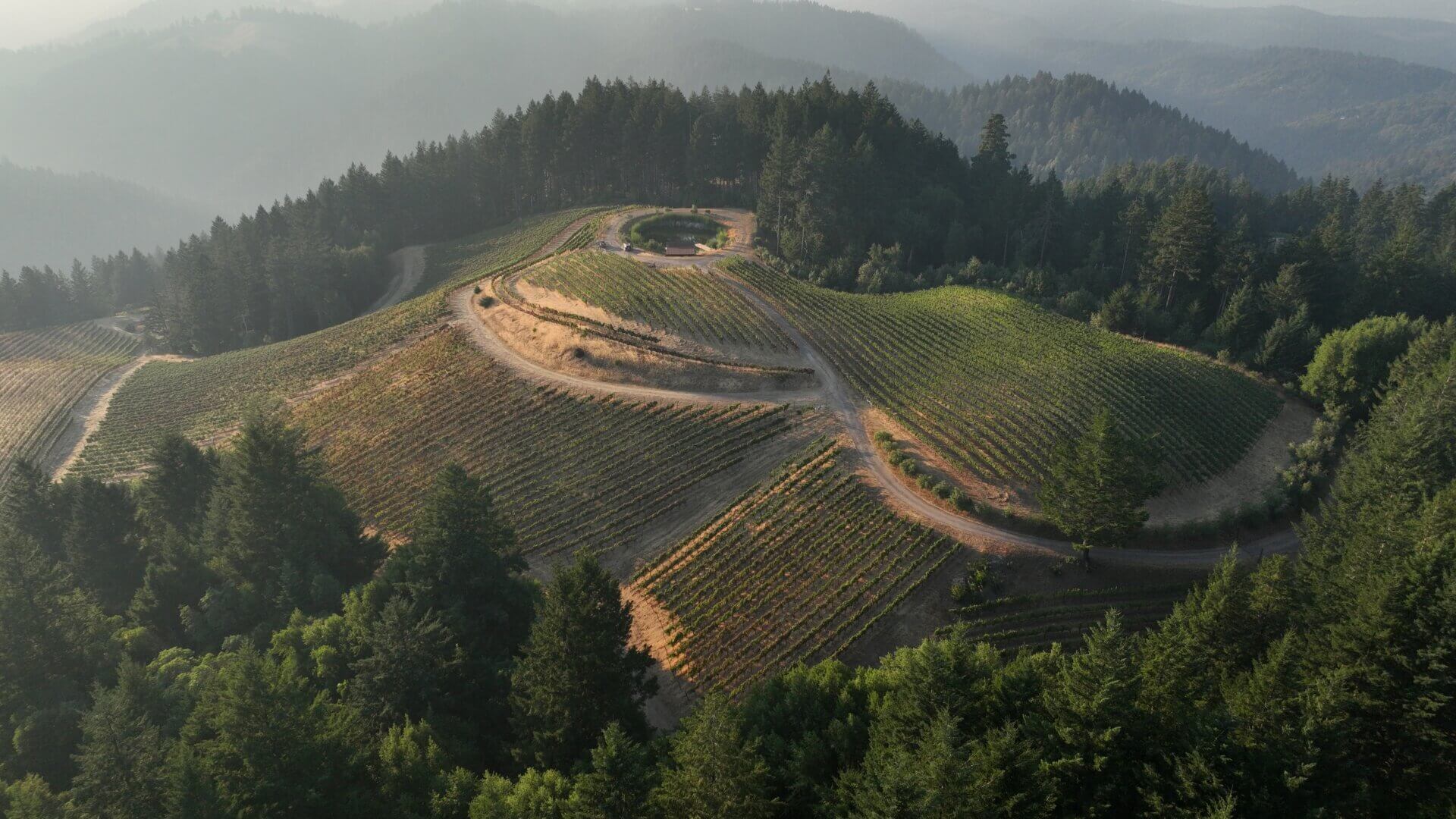
A drone shot of Signal Ridge Vineyard, which climbs to 2,742 feet in the Mendocino Ridge AVA.
The American wine industry is built on compelling stories: the Spanish missionaries of the Rio Grande Valley, the gold rush of 1849, the post-Prohibition era, the 1976 Judgment of Paris. But what tales does its future hold?
Simply put, the next chapters should zero in on our appellations. With an AOC system dating back to the 1930s, France has a multi-century head start on defining great terroir; the American AVA system, by contrast, is just 45 years old. Still, think of its progress—there are 269 AVAs today, with 149 of them in California alone. Yet while advocating for those AVAs is critical, I’d argue that the most vital assets we can promote are our best vineyards.
Burgundy has its hallowed appellations, but its importance comes down to its most prized Grand Cru sites: Échezeaux, La Romanée, and Corton, to name a few. And the California winemakers I spoke to all agree that we have our own Cortons and La Romanées—“vineyards that consistently make great wine with a personality and a DNA,” as winemaking consultant Jean Hoefliger puts it. “In Napa, of course, To Kalon [in Oakville] would come to mind.” La Pelle winemaker Maayan Koschitzky agrees that To Kalon is one of our top vineyards. “A great terroir is a true showcase of a great wine,” he says, adding that the best sites “outperform vintage and make standalone wines that are benchmarks year after year.”
But how do we identify them for consumers? Is it right to refer to these sites as “Grands Crus”? Joanna Wells, winemaker at Model Farm Wine and Signal Ridge Vineyard, thinks we shouldn’t have to. “We use the term ‘heritage’ to define vineyards that offer deep historical viticultural significance,” she says. “There are industrywide efforts [by] Historic Vineyard Society, Foundation Plant Services [and its] heritage clone collections, and Hudson Valley Heritage Wines, to name a few, [which] are working to protect these important vineyards and continue their legacy.”
Maya Dalla Valle of her namesake estate in Oakville argues, “There is an opportunity to create our own applicable terms and expressions and not co-opt the terms traditionally used in Bordeaux and Burgundy in the Napa Valley.” Instead of using the French terms “Grand Cru” and “Premier Cru” to identify the best American vineyards and communicate to the consumer that these sites hold the key to identifying fine wine, we could codify a system of vineyard classifications using words like “heritage,” as Wells suggests, or a host of other descriptors that could become U.S.-specific: “Signature” or “legacy” come to mind. Right now, there’s no wrong answer, but it is time to start the debate. Let’s draw definitive distinctions between European sites and American sites, because our legacy indeed depends on it.
Jonathan Cristaldi is an editor-at-large
for The SOMM Journal and The Tasting Panel and is also the Napa Valley correspondent for Decanter. Follow him on Instagram @jcristaldi.