

story by Stefanie Schwalb / photos by Michael Butcher

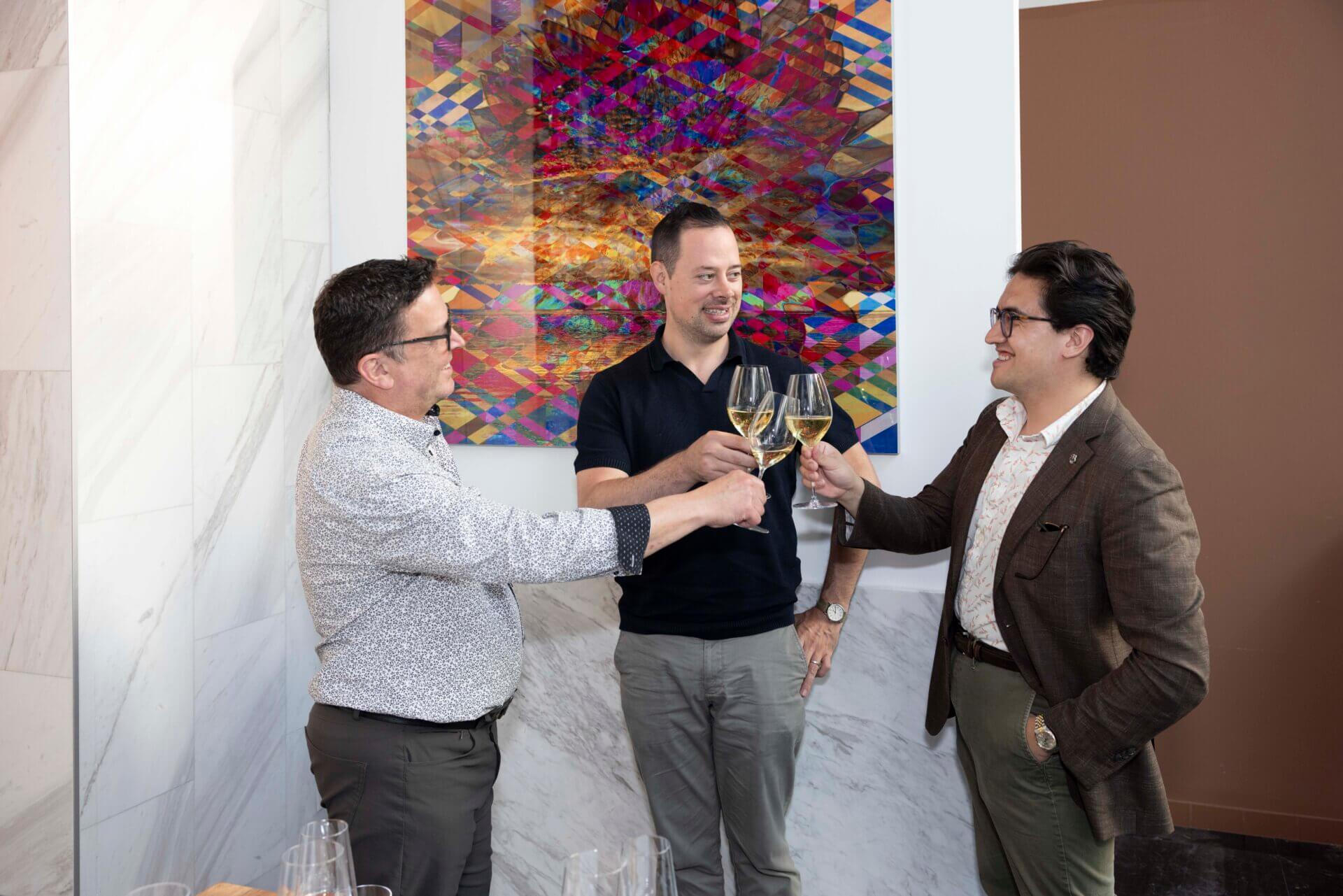
There was no better way to end the first day of the SommCon DC Summit than with a dinner specially prepared by chef Enrique Limardo at the MICHELIN-starred Imperfecto featuring Italian wines from the Veneto and Lombardy. Held on June 2, it was hosted by Tony Apostolakos, U.S. director at Masi Agricola, and Jacob Gragg, Ca’ del Bosco (cadelbosco.com) and portfolio wine senior manager for HERITA USA (formerly Santa Margherita USA). An intimate group of sommeliers and wine buyers from the Washington, D.C., area gathered for the experience.
As the evening began, guests were greeted with a glass of Ca’ del Bosco Cuvée Prestige Edizione 45 Extra Brut, the winery’s flagship label. Ca’ del Bosco is one of the oldest producers in Franciacorta, located in Lombardy almost equidistant between Verona and Milan at the foot of the Alps. Sourced from 218 certified-organic vineyards, the traditional-method multivintage blend contains Chardonnay, Pinot Bianco, and Pinot Noir; 68% of it is from 2020 and the remaining 32% from two other vintages. It features just 1 gram of residual sugar. “We’re drinking wine mostly based on Chardonnay,” said Gragg, “and it highlights what Franciacorta does best, which is showcase fruitiness without the need for much adulteration or almost any sweetness.”
Next came a sampling of Ca’ del Bosco’s 2016 Annamaria Clementi Dosage Zéro Riserva, served alongside a starter of oyster and foie gras, fish tart, and mushroom soup. Gragg shared that the wine was created before the Franciacorta Riserva category was established—and even before the region became a DOCG—and it served as an inspiration to extend aging regulations. “In 1995, there were no laws pertaining to extended aging; they were written around this singular wine, which was named after the mother of Maurizio Zanella, who founded the winery when he was 17 years old,” he explained. Also a blend of Chardonnay, Pinot Noir, and Pinot Bianco, it’s handpicked from certified-organic vineyards and undergoes oak fermentation, extended lees aging, and a patented oxygen-free disgorgement process with no additional dosage. This disgorgement process, which was invented in 2004, isn’t the only innovation the winery has implemented in recent decades; Gragg also noted that, since 2013, every grape used in Ca’ del Bosco’s production is fully washed and dried before fermentation to preserve the wines’ purity and expression.
Next came a sampling of Ca’ del Bosco’s 2016 Annamaria Clementi Dosage Zéro Riserva, served alongside a starter of oyster and foie gras, fish tart, and mushroom soup. Gragg shared that the wine was created before the Franciacorta Riserva category was established—and even before the region became a DOCG—and it served as an inspiration to extend aging regulations. “In 1995, there were no laws pertaining to extended aging; they were written around this singular wine, which was named after the mother of Maurizio Zanella, who founded the winery when he was 17 years old,” he explained. Also a blend of Chardonnay, Pinot Noir, and Pinot Bianco, it’s handpicked from certified-organic vineyards and undergoes oak fermentation, extended lees aging, and a patented oxygen-free disgorgement process with no additional dosage. This disgorgement process, which was invented in 2004, isn’t the only innovation the winery has implemented in recent decades; Gragg also noted that, since 2013, every grape used in Ca’ del Bosco’s production is fully washed and dried before fermentation to preserve the wines’ purity and expression.

For the final Ca’ del Bosco wine of the evening, guests were treated to the 2015 Annamaria Clementi Rosé Extra Brut Riserva, paired with a crudo of local shrimp, cocktail sauce, zucchini, and caviar. Gragg described it as the winery’s smallest-production wine, made only in select vintages; indeed, between 2003—the year of the wine’s inception—and 2015, three vintages were skipped. Made entirely of hand-harvested Pinot Noir from three organic vineyards in the town of Erbusco where Ca’ del Bosco is based, the wine is 100% fermented in barrel and undergoes an extended period of aging on the lees. Like the first wine we had tasted, it sees a small amount of dosage: 1 gram of sugar. “It’s a very special wine,” said Gragg. “[In fact,] in 2015, we made just over 3,000 bottles of it, so we’re literally drinking 2% of America’s allocation.”
The focus then shifted east of Lake Garda in Lombardy to Valpolicella in Verona as Apostolakos introduced Masi Agricola, a seventh-generation family-owned winery that has just completed its 253rd vintage, and the four red wines he had chosen to represent the region. The climate of Valpolicella, situated between Lake Garda and the Dolomites, plays a major role in the wines’ character, he explained: “That whole area of Valpolicella is interesting because to the west you have Lake Garda, and to the north, they’re skiing up in the Dolomites.” This incredible mix of thermal influences—cool alpine air from the mountains and warm breezes from the lake—creates a unique microclimate ideal for growing grapes.
Now in its seventh generation of family ownership, Masi Agricola has deep roots in the Veneto region; the Boscaini family has actually been making wine in Valpolicella since the 18th century. Apostolakos introduced Valpolicella’s traditional trio of grapes, Corvina, Rondinella, and Molinara, by noting that they’re collectively known as “the grandmother’s recipe”—although, he added, “we don’t use her kitchen,” meaning that production techniques have progressed substantially over the decades. The wine they yield, he further acknowledged, hasn’t always had a stellar reputation. “Valpolicella on its own has a nice freshness, brightness, and good acidity, but it’s not meant to be drunk for serious flavor,” he said. “One way to add intensity and complexity is by doing something called appassimento.” At Masi, this is done using bamboo racks and precise airflow techniques. While most people think the grapes are just being dried out, the process actually changes them: As the water evaporates, the flavors get more concentrated, and the grapes develop deeper, more complex notes. “These grapes have thick skins and the ability to dry for a long time. They don’t just dehydrate; they improve,” Apostolakos asserted. Historically, the technique led to the creation of Recioto, a sweet wine that eventually evolved to become Amarone in the 1950s. “The Venetians wanted to make a more interesting wine,” he explained, and did so by allowing the wine to fully ferment to dryness.
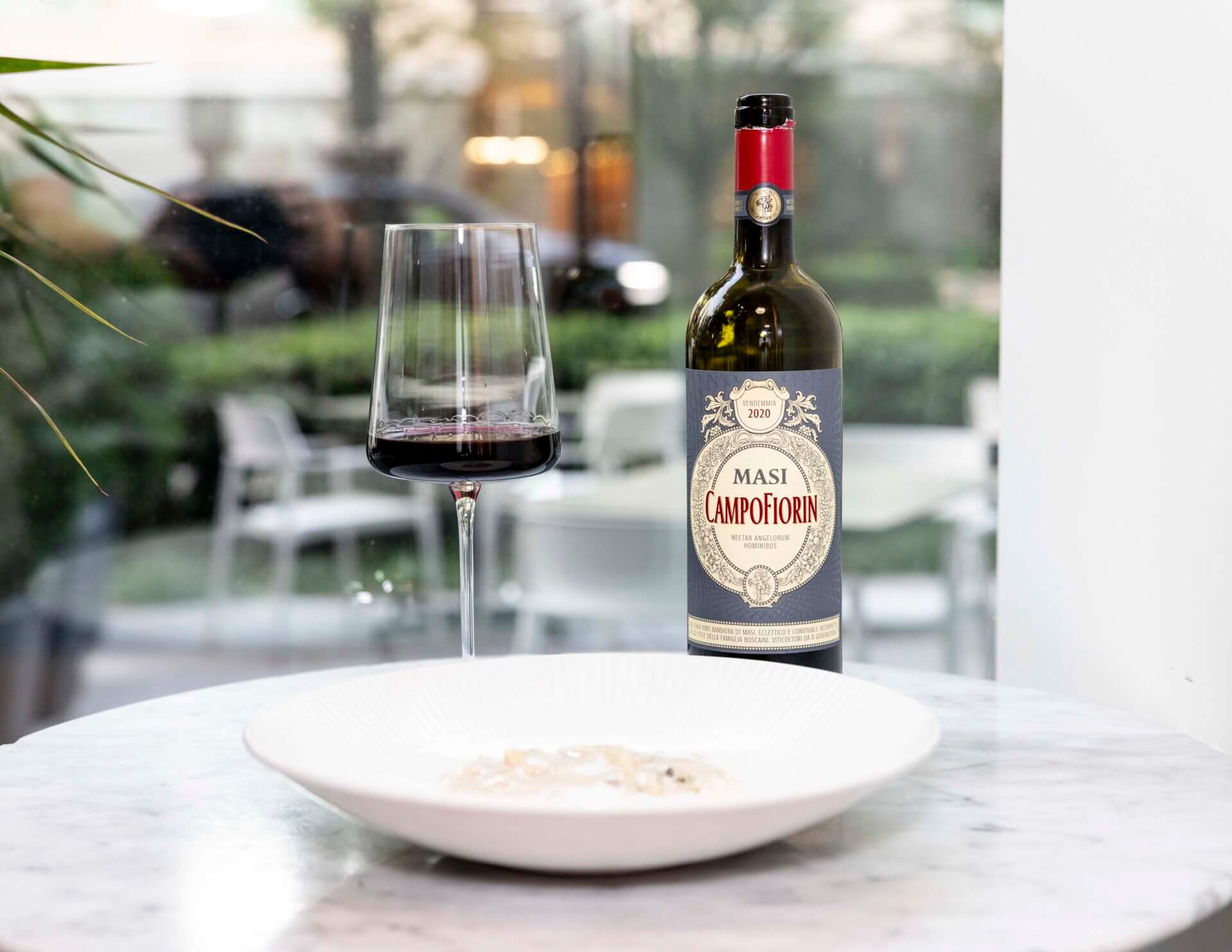
The first Masi wine poured was the 2020 Campofiorin Rosso Verona, paired with a risotto featuring artichokes, cacao nib mojito, and a cacio e pepe foam. First created in 1964, Campofiorin was developed as a bridge between Valpolicella and Amarone. It uses a double fermentation technique whereby the base wine is made from fresh grapes before a portion of semi-dried grapes is added for a second fermentation about six weeks later. “As producers, we needed a wine that could show a positive impression of the area,” Apostolakos explained. “This had ripeness, freshness, integrity, and drinkability. Campofiorin became a great wine that could expose the world to the potential of Valpolicella.” He noted that the wine became important for the winery and the region as a whole for that reason.
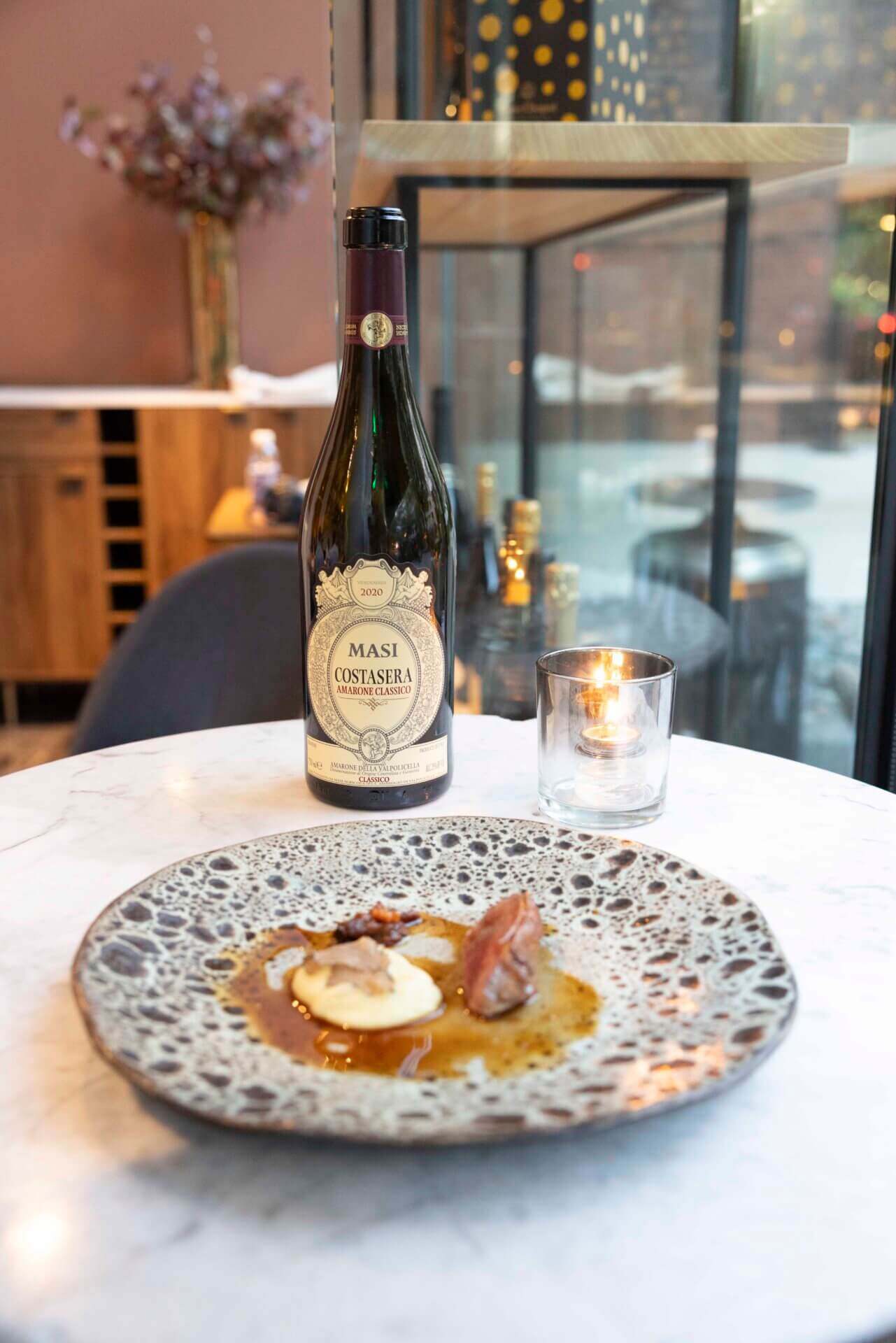
Two Amarones came next: the 2020 Costasera Amarone della Valpolicella Classico, paired with a squab duo of aged breast and confit leg, sweet potato aligot, truffle, and jus, and the 2018 Costasera Amarone della Valpolicella Classico Riserva, served with wagyu rib-eye from the Mishima Reserve program in a morel sauce. Apostolakos described Costasera as a label that sources fruit from five vineyards across five valleys overlooking Lake Garda. While both the Classico and the Riserva contain Corvina, Rondinella, and Molinara, the Riserva comes from a special selection of grapes—typically less than 5% of the fruit that goes into the standard Costasera Amarone. In addition, fruit for the Classico undergoes appassimento for 100 days while the Riserva fruit sees closer to 110 days. The longer they dry, the more complex the wine, according to Apostolakos. Both wines are aged in Slavonian oak barrels—the Classico for 28 months, the Riserva for 38–40 months. And finally, the Riserva also includes a small amount of Oseleta, a variety rediscovered by Masi owner Sandro Boscaini in the 1980s. “[In fact], he petitioned the Consortium, saying, ‘You must put this varietal back and have it as an optional grape,’” Apostolakos noted. “Today, producers use it to add structure, and some even replace Molinara with it.”
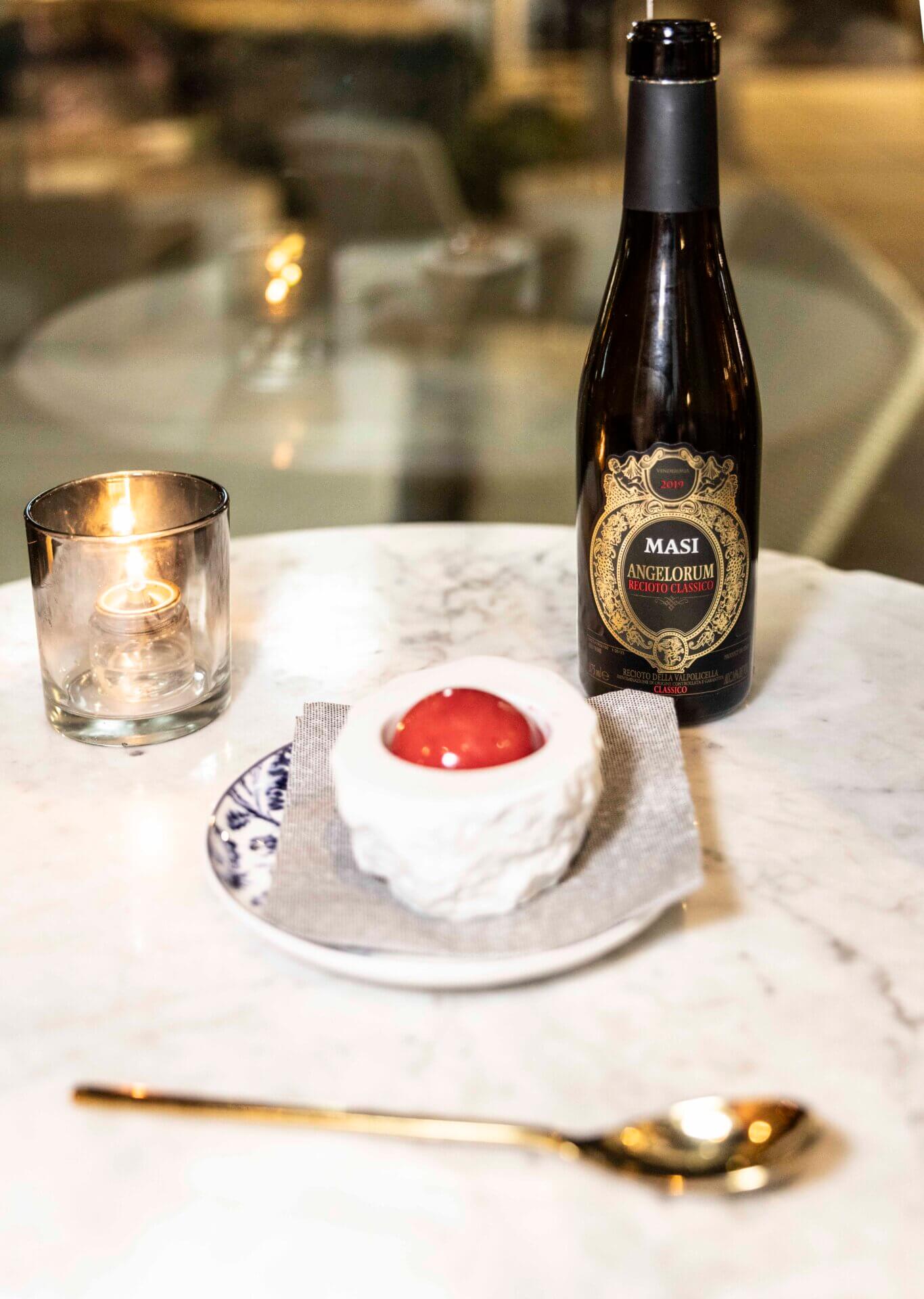
To end the evening, the 2019 Angelorum Recioto della Valpolicella Classico was served with Cacao 7, a layered dessert built around seven distinct chocolate elements, including a cacao cookie, sorbet, ganache, custard, a caramel tuile, a feuilletine crisp, and gelée. Made from Corvina, Rondinella, and Molinara and dried for about 100 days, the wine underwent a truncated fermentation to preserve the residual sugar, resulting in a wine with 14%–14.5% alcohol. “We’re not drying them longer to get the sugar higher. We’re not doing a late harvest. We’re doing almost virtually the same technique [as for our table wines],” Apostolakos said. “But during the fermentation we will stop it, lower the temperature, and rack the wine, so the residual sugar is very high.” The result is a wine of balanced richness that’s ideal after dinner but also very impressive to drink on its own. “It’s got acidity and doesn’t have that slow, cloying sensation you get from a late harvest or ice wine,” noted Apostolakos.
Attendees were impressed by the whole experience. Thomas Delasko, general manager and sommelier at Via Sophia, praised the food pairings as “fantastic with Ca’ del Bosco” and called the Masi Riserva one of the most incredible Amarones he’s ever tasted. “It paired fantastically with the wagyu,” he added. Brent Kroll, owner of Maxwell Park and Pop Fizz Bar, emphasized the importance of mastering wines like these before exploring lesser-known Italian offerings: “These are classics in their regions and appellations, and they need to be learned before you get into obscure stuff that doesn’t have the same depth of history. They define what it means to take care of the grapes you’re growing and the place where you come from. These are the people doing it the right way.”
